Skip to content
PS5PCEM
In-gameReaches in-game scenes

Ghost of Yōtei

Intro playback · bonus notices · brightness calibration · reaches in-game scenes · not playable

This is the project's hardest test case and its most documented one. Intro movies play with sound, the bonus notices and brightness calibration appear, and later 3D scenes including the tree scene reach the screen. None of that is playable: scene frames arrive at well under 1 FPS, and a complete playthrough is not claimed.

Test host
NVIDIA GeForce RTX 3070 Ti
Build
0.3.2
Recorded runs
24
Confirmed
October 1, 2026
Ghost of Yōtei Digital Deluxe Bonus notice, rendered by PS5PCEM

What works

  • Intro movies play at roughly their native 30 FPS, with audio starting in step with the track.
  • The loading indicator, bonus notices and the brightness calibration screen with its wolf image, slider and prompt all render.
  • Later 3D scenes, including the tree scene, reach the screen with menu music audible.

What does not

  • Gameplay — moving a character through a loaded world — remains unverified.
  • Scene preparation is extremely slow, and a transition frame was measured at 167.2 s, of which 164.8 s created 206 compute pipelines.
  • Two recent checks stalled awaiting GPU completion before the tree scene and were terminated deliberately after diagnostics.
  • Invalid indirect draws, a corrupt-count failure, streaking and excessive brightness are all still open.

Measured performance

October 3 baseline tree measurements before the dynamic-state change: 0.83–0.97 FPS over 30-second presentation-counter intervals. The earlier 0.73 FPS result is historical. These are tree/setup measurements, not post-cinematic gameplay. Different cache histories prevent a controlled before/after comparison.

NVIDIA GeForce RTX 3070 Ti

Result

Test history

Every recorded run for this title, newest first. Entries marked as a development build were never published as a release.

  1. Pause overlay over the incomplete post-tree cinematic
    Development build

    Post-tree bottlenecks and lower cache memory

    The repeat reaches the post-tree 3D cinematic, with incomplete lighting and character surfaces. The tree remains at 1.231 FPS; a later cinematic interval presents two frames in 30 seconds (0.067 FPS). One 198-second transition frame spends 177 seconds creating pipelines. Later frames also reload 1.4–2.6 GiB of textures. Shader variants now share canonical program bytes, and large Windows driver-cache snapshots use a temporary file mapping. A 256 MiB isolated snapshot test saves about 256 MiB of additional private memory and produces identical files. All 21 cache tests and three native Vulkan probes pass. These memory changes have no new game FPS measurement; character control remains unconfirmed.

    Read the report →
  2. Development build

    Color export masks and attachment routing

    The renderer now respects shader channel masks and routes compact color exports to the intended surfaces, including gaps between attachment slots. Six native Vulkan probes pass, checking retained pixels, mixed packing formats and pipeline reuse after a mask change. Active packed UNORM blending remains explicitly unsupported. Compiler experiments did not establish a useful speedup and were not enabled in the game. The repeat records 1.231 FPS at the tree and reaches the incomplete post-tree cinematic; character control is unconfirmed.

    Read the report →
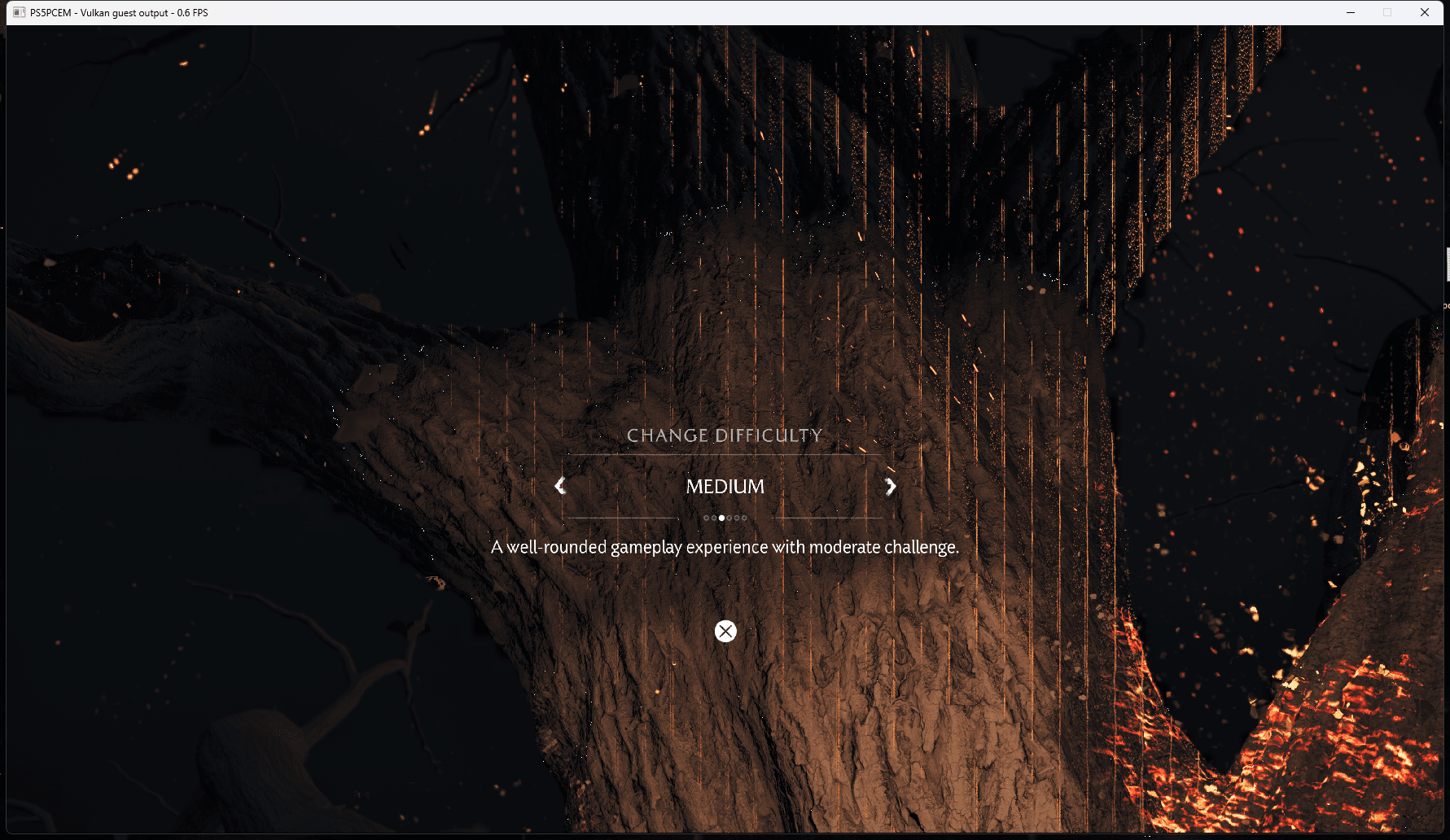
  3. Medium difficulty menu with runtime texture lookups; bright tree streaks remain
    Development build

    Runtime texture tables and recovered disk cache

    Small indirect texture tables now keep descriptor addresses in runtime data, avoiding new pipelines solely for relocation or changed hash collisions. A native probe verifies three correctly rendered passes with one compilation; nine Vulkan checks pass. The live disk cache resumed saving after redundant probe-cache copies were removed. Save failures now report an error and retry while retaining the previous cache. No new game FPS gain or character control is confirmed; tree streaks, lighting defects and packed-color blending remain open. The repeat presents 37 frames in 30.049 seconds at Medium difficulty (1.231 FPS), matching the previous tree measurement.

    Read the report →
  4. Tree at difficulty selection in the installed selected-FLAT runner; bright vertical streaks remain
    Development build

    Fewer snapshot reads; lower compiler cost

    Bounded FLAT reads now select the matching buffer before loading data, preserving overlaps, unaligned addresses and fault reports. In a controlled shader replay, compilation falls from 46.55 to 39.36 seconds and peak private memory from 3.96 to 3.37 GB. A slower loop variant was discarded. Native Vulkan checks pass. These are compiler results, not game FPS; tree streaks, incomplete later rendering and unconfirmed character control remain. The installed runner records 37 frames in 30.046 seconds at the tree (1.231 FPS), with no demonstrated frame-rate improvement.

    Read the report →
  5. Development build

    First-use shader compilation and memory pressure

    A live thread audit confirms driver compilation during the post-tree stall. The captured original compute module takes 59.47 seconds and peaks at 7.40 GB of private memory in an isolated probe. Reusing its saved cache entry takes 14 ms; the old cache is backed up for the next game repeat. Offline SPIR-V optimization does not materially improve this case. These are compiler measurements, not gameplay FPS. Tree streaks and incomplete later rendering remain, and character control is unconfirmed.

    Read the report →
  6. Development build

    Less shader-cache memory; tree at 1.26 FPS

    Unused diagnostic shader IR is now released during decoded-stream execution. At the tree, 648 cached analyses retain zero bytes in those extra arrays; their original code and decoded instructions remain intact. The repeat presents 38 frames in 30.044 seconds (1.26 FPS), within the previous sample range, so no repeatable speedup is established. Five focused tests and native Vulkan image/material probes pass. Tree streaks remain and character control is unconfirmed. The local runner and matching PDB are updated with a backup.

    Read the report →
  7. Incomplete post-tree scene with missing material and lighting detail
    Development build

    Tree repeat: 1.23 FPS, post-tree memory limit

    The updated local runner presents 37 frames in 30.043 seconds at the tree (1.23 FPS), with no demonstrated gain over the preceding 1.26 FPS sample. It reaches an incomplete 3D cinematic, with long first-use pipeline compilation and unsupported packed-color blending. The diagnostic guard stops the run after 1,158 seconds as system commit approaches its limit. Character control remains unconfirmed; the capture shows unresolved material and lighting defects.

    Read the report →
  8. Development build

    Sparse material indices and smaller shaders

    The preceding tree repeat records 1.26 FPS; severe first-use stalls and dark post-tree rendering remain. Texture discovery now retains the possible masked indices instead of every intermediate record. Adjacent captured memory pages share one checked region. A native wide-table fragment is 22.8% smaller with the same pixel result; 12 memory-read cases and 26 sampler cases pass Vulkan validation. The game repeat is ongoing. A game FPS gain and character control are not yet confirmed.

    Read the report →
  9. Development build

    Integer material indices and checked memory reads

    The captured material table now resolves 84 valid 2D textures instead of 229 candidates containing false array images. The live run passes that lookup and exposes a later unsupported FLAT read. A new checked memory path passes ten Vulkan cases; 26 sampler cases also pass. The preceding tree repeat records 1.16 FPS, with no demonstrated speedup. First-use pipeline compilation and host memory pressure still cause severe stalls. Lighting defects remain and character control is unconfirmed.

    Read the report →
  10. Incomplete character surfaces after the tree in the material-pointer repeat
    Development build

    Material sampler recovered; severe post-tree stalls remain

    The combined sampler/cache repeat records 1.23 FPS at the tree and five frames in 60 seconds after it (0.083 FPS). A different cinematic interval prevents claiming a speedup. The original material rejection is passed; a later texture lookup in the same shader remains unsupported. Signed-index tests and 26 native Vulkan cases pass. Tree streaks, incomplete lighting and packed-color blending remain unresolved. Character control is not reached. The candidate stays isolated; the installed runner is unchanged.

    Read the report →
  11. Incomplete characters in the dark post-tree cinematic
    Development build

    Tree repeat at 1.30 FPS; material-pointer recovery

    The content-generation repeat presents 39 frames in 30 seconds at the tree and only four in 60 seconds in the dark cinematic. Lighting and character geometry remain incomplete; character control is unconfirmed. A captured shader replay now resolves 60 texture descriptors. Ten native Vulkan cases verify sparse material tables and report an error when an active shader selects an unsupported record. Game validation of the new material fix is pending.

    Read the report →
  12. Dark post-tree cinematic with unresolved lighting and geometry defects
    Development build

    Packed color repeat; content-cache and memory fixes

    The packed UNORM candidate records 1.23 FPS at the tree. A later dark cinematic stalls at one frame in 60 seconds; this is not steady gameplay FPS. Lighting and geometry remain broken, and a blended color pass is unsupported. Further cache-generation and memory-batch fixes pass seven Vulkan probe groups and five kernel tests; their game benefit is not yet measured. Character control is unconfirmed.

    Read the report →
  13. Tree difficulty screen; bright streaks remain
    Development build

    Shared color transfers; tree repeat at 1.40 FPS

    The runner removes separate host readback buffers for color targets. Brightness and tree repeats each present 42 frames in 30 seconds, about 1.40 FPS versus 1.26 previously. Cache history differs, so this does not isolate the improvement. Tree streaks remain; the illustrated movie is reached, but character control is unconfirmed.

    Read the report →
  14. Illustrated movie after the tree and dark cinematic; character control unconfirmed
    Development build

    Illustrated movie reached; compute compilation stalls

    The updated runner passes the tree and dark cinematic into the illustrated narrative movie. Character control is still unconfirmed. The tree repeat remains 1.26 FPS; the read-only texture reuse fix shows no additional game FPS gain. One later frame takes 239.4 seconds, including 234.9 seconds creating compute pipelines. A live texture-cache increase coincides with the scene change and proves no speedup. Lighting, streaks and a missing pixel-shader resource remain open.

    Read the report →
  15. Very dark cinematic after the tree; character control is not confirmed
    Development build

    Post-tree cinematic: compilation and texture churn

    The combined build reaches a very dark cinematic after setup. One cold frame takes 59.3 seconds, including 35.4 seconds of graphics pipeline creation. Reducing caches to contain memory use causes several GiB of texture uploads per frame. A separate Vulkan regression verifies that read-only storage bindings no longer invalidate sampled textures. Gameplay FPS and character control are still unconfirmed; streaks and a missing pixel-shader resource remain.

    Read the report →
  16. Tree bark and branches are visible; bright vertical streaks remain
    Development build

    Array-layer coherence: tree detail returns

    Restricting color-surface tracking to the selected slices prevents neighboring layers from invalidating GPU contents. Compatible sampled arrays now refresh dirty layers on the GPU. A 30-second tree interval records 1.23 FPS versus 1.03 in the control, with differing animation phases and cache history. Bark is visible again, but bright streaks remain. Loading beyond setup still reaches the host memory limit; character control is unconfirmed.

    Read the report →
  17. Candidate check: tree smearing remains
    Development build

    Candidate check: tree smearing remains

    The third run measures 1.30 FPS at the tree with different cache budgets, but the image is more smeared. Restoring the render-target limit does not visibly fix it. The user closes the run during scene preparation; post-cinematic gameplay is not confirmed. This is not a verified FPS gain, and the installed runner remains the baseline pending a clean visual comparison.

    Read the report →
  18. Tree at difficulty selection, with vertical bright streaks still visible
    Development build

    Tree measurements and graphics pipeline reuse

    Before the change, tree intervals measure 0.83–0.97 FPS. Two attempts to continue beyond the tree are deliberately stopped near the Windows commit limit. Dynamic depth bias and stencil references remove 61 redundant variants from a 1,007-pipeline snapshot; GPU probes pass. This is not a measured gameplay FPS gain, and the bright streaks remain.

    Read the report →
  19. Ghost of Yōtei Digital Deluxe Bonus notice before the October 1 GPU wait, rendered by PS5PCEM
    Development build

    All-zero textures treated as unbound, and faster descriptor recovery

    Textures proven to be entirely zero now use unbound-image semantics instead of rejecting the shader, and scalar descriptor recovery reuses intermediate values within a call — a nested fixture dropped from 504 reads to 18 and ran about 4.6× faster in isolation. Two checks of the installed runner still stalled awaiting GPU completion before the tree scene and were stopped deliberately after diagnostics.

    Read the report →
  20. Ghost of Yōtei tree scene after the command-write corrections, rendered by PS5PCEM
    Development build

    Command-processor writes survive deferred readback

    An explicit command-processor write inside a cached storage buffer could be lost when an older GPU result was published over it, because the flush path only matched a buffer's base address. Indexing overlapping buffers and publishing only proven write ranges fixed the resulting header corruption.

    Read the report →
  21. Ghost of Yōtei tree scene rendered by PS5PCEM
    Release 0.3.2

    Movie audio works and later 3D scenes appear

    Intro movies gained sound, starting in step with the audio track rather than staying silent, after multichannel ATRAC9 was decoded as interleaved mono streams across layouts from 2 to 36 channels. The run reached later 3D scenes including the tree scene, at 0.73 FPS, and the following loading sequence lost the Vulkan device.

    Read the report →
  22. Ghost of Yōtei difficulty selection over a loaded 3D scene, rendered by PS5PCEM
    Release 0.3.1-beta.1

    Difficulty selection renders over a loaded 3D scene

    Menu composition reached difficulty selection drawn over real 3D geometry, with trees and parts of the background visible and menu music playing. Getting there took several minutes of intro and scene loading, and frames arrived at 0.6 FPS.

    Read the report →
  23. Ghost of Yōtei brightness calibration screen with the wolf image, rendered by PS5PCEM
    Release 0.3.0-alpha.4

    Through the intro to the bonus notices and brightness calibration

    Intro playback became continuous at roughly the stream's native 30 FPS, and the run advanced through streamed menu resources into the loading indicator, the Digital Deluxe Bonus, Gift of the Northern Star and Pre-order Bonus notices, and brightness calibration — wolf image, instructions, slider and confirmation glyph all readable.

    Read the report →
  24. A Ghost of Yōtei intro frame decoded and presented by PS5PCEM
    Release 0.3.0-alpha.3

    The intro video decodes and plays

    H.264 access units handed to the guest video library are now decoded on the host, converted from NV12 with BT.709 coefficients, and paced at about one picture per display interval so a title feeding frames as fast as they are accepted no longer burns through a whole movie in seconds. The in-engine frame behind the video was still black, so this was a playback milestone only.

    Read the report →

Captures

Captures

Frames produced by the emulator itself during the runs above.

Pause overlay over the incomplete post-tree cinematic

Post-tree bottlenecks and lower cache memory

October 5, 2026

Medium difficulty menu with runtime texture lookups; bright tree streaks remain

Runtime texture tables and recovered disk cache

October 5, 2026

Tree at difficulty selection in the installed selected-FLAT runner; bright vertical streaks remain

Fewer snapshot reads; lower compiler cost

October 4, 2026

Incomplete post-tree scene with missing material and lighting detail

Tree repeat: 1.23 FPS, post-tree memory limit

October 4, 2026

Incomplete character surfaces after the tree in the material-pointer repeat

Material sampler recovered; severe post-tree stalls remain

October 4, 2026

Incomplete characters in the dark post-tree cinematic

Tree repeat at 1.30 FPS; material-pointer recovery

October 4, 2026

Dark post-tree cinematic with unresolved lighting and geometry defects

Packed color repeat; content-cache and memory fixes

October 4, 2026

Tree difficulty screen; bright streaks remain

Shared color transfers; tree repeat at 1.40 FPS

October 4, 2026

Illustrated movie after the tree and dark cinematic; character control unconfirmed

Illustrated movie reached; compute compilation stalls

October 4, 2026

Very dark cinematic after the tree; character control is not confirmed

Post-tree cinematic: compilation and texture churn

October 4, 2026

Tree bark and branches are visible; bright vertical streaks remain

Array-layer coherence: tree detail returns

October 4, 2026

Candidate check: tree smearing remains

Candidate check: tree smearing remains

October 3, 2026

Tree at difficulty selection, with vertical bright streaks still visible

Tree measurements and graphics pipeline reuse

October 3, 2026

Ghost of Yōtei Digital Deluxe Bonus notice before the October 1 GPU wait, rendered by PS5PCEM

All-zero textures treated as unbound, and faster descriptor recovery

October 1, 2026

Ghost of Yōtei tree scene after the command-write corrections, rendered by PS5PCEM

Command-processor writes survive deferred readback

September 30, 2026

Ghost of Yōtei tree scene rendered by PS5PCEM

Movie audio works and later 3D scenes appear

September 24, 2026 · v0.3.2

Ghost of Yōtei difficulty selection over a loaded 3D scene, rendered by PS5PCEM

Difficulty selection renders over a loaded 3D scene

September 15, 2026 · v0.3.1-beta.1

Ghost of Yōtei brightness calibration screen with the wolf image, rendered by PS5PCEM

Through the intro to the bonus notices and brightness calibration

September 8, 2026 · v0.3.0-alpha.4

A Ghost of Yōtei intro frame decoded and presented by PS5PCEM

The intro video decodes and plays

September 4, 2026 · v0.3.0-alpha.3

24

Recorded runs

NVIDIA GeForce RTX 3070 Ti

0.3.3

Current build

October 4, 2026

In-game

Result

Reaches in-game scenes

Other titles

Playthrough reports carry the date the maintainer confirmed them. Every timing refers to the NVIDIA GeForce RTX 3070 Ti development machine and will differ on other hardware. Game content is supplied locally and is never distributed here.